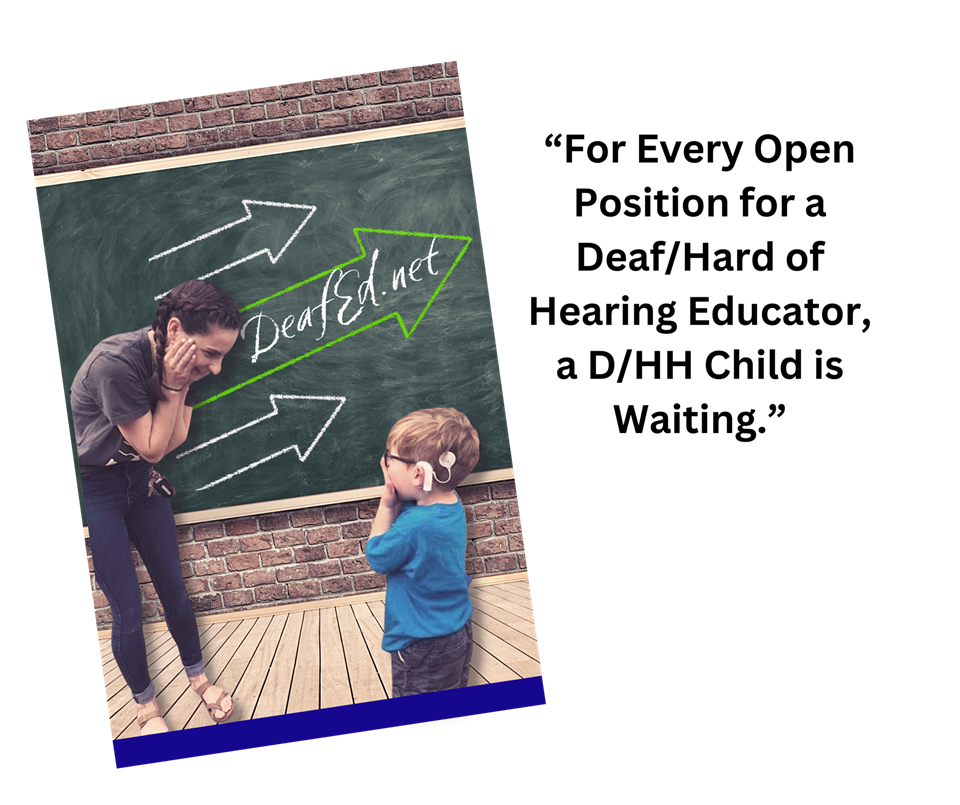
Deaf Education
Home Page
Key words: Announcements, Activities and Projects
Free Materials and Information
The Captioned Films/Videos (CVF) program provides FREE LOAN educational and general interest captioned films and videos. These materials are made available by the U.S. Department of Education.
Deaf and hard of hearing individuals qualify for CFV service. Teachers, parents, and others who work with individuals who have a hearing loss also qualify.
Free materials and information about the CFV program and on captioning is available.
Materials are available via U.S. mail and electronic mail (E- mail)
CFV Program
Captioned Films/Videos (CFV): A Free Loan Service (NADH-19)
Brochure describes types of materials available, eligibility
requirements, and contains a registration form.
CFV Program Overview (NADH-12)
A brief (6 pages) review of the past, the present, and how
CFV videos are selected, captioned, and distributed.
CFV Video Evaluation (NADH-14)
Reviews the CFV program selection process for both
educational and special interest videos. Includes criteria used
by video evaluation teams in the selection of videos to be
captioned.
Captioned Films/Videos: Information for Parents (NADH-1)
Reprinted from The Endeavor, Spring , 1992. What the CFV
program offers and how parents can encourage its use in the
schools and in the home.
A Film and Video Decalogue for Pedagogues (NADH-9)
Lesson guides have been written for all videos selected for
the CFV educational program. This article describes these guides
and provides film/video utilization tips.
Guidelines for Captioning CFV (NADH-5)
Funds for captioning are provided by the U.S. Department of
Education (ED). In its contractual statement of work the ED
specifies captioning requirements. The NAD provides technical
assistance to video companies and captioning service vendors
regarding this captioning, and the NAD performs a review of the
captioning work. These guidelines list CFV captioning
specifications and requirements.
Declare Your Captioning Needs! (Educational CFV) (NADH-2)
Captioned Films/Videos Recommendations Form (General Interest
CFV) (NADH-18)
These two forms provide opportunity for registered users to
recommend videos for captioning. Recommendations may be made by
specific title or by subject area. User input determines what is
captioned for CFV.
U.S. Department of Education - Approved Captioning Service
Vendors (NADH-11)
Names, addresses, and phone/fax numbers of captioning
agencies who have successfully completed an evaluation by the NAD
and are approved by the Department to perform CFV captioning
work.
Captioning Evaluation (NADH-27)
Preliminary information provided to captioning agencies who
want to apply for the U.S. Department of Education "Approved
Captioning Service Vendor" list. Requirements for format, text,
rate, method and style, and editing are reviewed.
Deaf Travelers on the Superhighway of Information (NADH-8)
Reprinted from AIME News, February, 1994. Provides
statistical and general information related to the access of deaf
persons to the Superhighway. Also reviews captioning
considerations for video producers.
Video Captioning: Who Benefits? (NADH-15)
Reviews the requirements of the law, the benefits of
captioning, and difference between "open" and "closed" video
captioning.
Captioning Preferences (NADH-3)
Reprinted from the NAD Broadcaster, June, 1994. A Gallaudet
University questionnaire determines the deaf viewer's opinions
about format features of current and future captioned television.
Caption Features for Indicating Non-Speech Information:
Research toward Standardization (Preliminary Results) (NADH-4)
Preferences of the deaf community for captioning music,
sound effects, singing, whispered speech, and other. Research
conducted by Gallaudet University.
Must We Put Up With Poor Captioning? (NADH-6)
Reprinted from the Silent News, July, 1994. Frustrations of
a deaf person in New York.
Planning to Upgrade Your Caption Decoder? (NADH-7)
Reprinted from the Silent News, March, 1994. Reasons for
retiring old TeleCaption adapters.
Captioning Service Providers (NADH-10)
Names, addresses, and phone/fax numbers of captioning
agencies across the United States.
TV Decoder Circuitry Act (NADH-13)
Basic information and provisions of the 1990 law requiring
built-in decoder circuitry are presented on one-half page.
Communicating Access: The Case for Closed Captioning
Videotapes (NADH-16)
Reprinted from National Video Resources Reports, December,
1994. How captioning removes communication barriers, the value
of captioned videos for groups such as English as a Second
Langauge, selecting a captioning vendor, and other information.
ADA, the Decoder Circuitry Act, and Communication Access
(NADH-17)
Reprints and other information regarding requirements of the
law. Suggestions for implementation of equal communication
access.
Video Producer/Distributor Captioning Survey Results (NADH-21)
In October 1994, the NAD sent a survey to several hundred
producers/distributors of educational and general interest
videocassettes. Compiled responses provide insight into the
number of videocassetes being captioned and the degree of
interest from buyers for closed-captioned videos.
Free Materials and Information (NADH-20)
Additional copy of this form.
The National Association of the Deaf (NADP-1)
This brochure overviews the mission and programs of the NAD.
Contains a membership form.
For More Information:
Captioned Films/Videos Program
1447 E. Main St.
Spartanburg, SC 29306
(803) 576-9303 voice
(803) 576-9175 TTY
(803) 576-9228
E-mail NADCFV@AOL.COM
Visti the CFV web site at http://www.cfv.org
Uploaded by: Melissa Close/Kent State University/Deaf Education Major.